
Ordering the wrong mud pump liner costs more than money — it costs rig time, crew hours, and in the worst case, a stuck pipe or lost circulation event because the pump couldn’t maintain pressure when it mattered most. Yet liner selection is often treated as a routine purchasing task rather than the engineering decision it actually is. This guide walks you through the complete selection process, from reading your pump nameplate to comparing supplier certifications, so your next liner order arrives exactly as specified and performs as expected.
Step 1: Identify Your Pump Model and Liner Specifications
Every liner order starts with three pieces of information. Get these right, and everything else follows. Get them wrong, and you’ll be on the phone with your supplier within hours of delivery.
1. Pump Brand and Model
This sounds obvious, but confusion arises because the same pump may be referred to differently by the OEM, the drilling contractor, and the procurement department. For example, the BOMCO F-1600 is sometimes listed as “F1600,” “F-1600HL,” or simply “1600 pump.” Always cross-reference with the pump nameplate and the OEM manual.
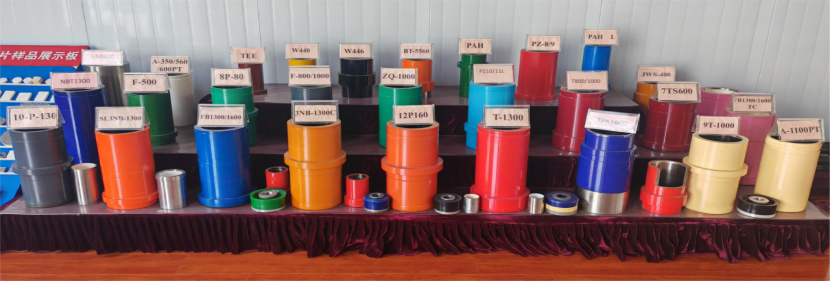
Common mud pump brands and their typical model designations:
| OEM Brand | Typical Model Format | Example |
|---|---|---|
| BOMCO | F + horsepower | F-500, F-800, F-1000, F-1300, F-1600, F-2200HL |
| EMSCO | F / FB / FC + horsepower | F-500, FB-1300, FC-1600 |
| NATIONAL | Piston diameter + pump series | 7-P-50, 10-P-130, 12-P-160 |
| OILWELL | A + horsepower + PT | A-600PT, A-1400PT, A-1700PT |
| GARDNER DENVER | PZ / PAH + model number | PZ-7, PZ-8, PZ-9, PZ-10, PZ-11 |
| IDECO | T + horsepower | T-500, T-800, T-1300, T-1600 |
| HONGHUA | HHF + horsepower or 3NB series | HHF-1600, 3NB-1300F, 3NB-1600F |
2. Liner Bore Diameter (Size)
The liner bore diameter — typically between 3 inches (75 mm) and 8 inches (200 mm) — determines the pump’s displacement per stroke and maximum pressure rating. This is not an arbitrary choice; it is selected based on the well’s hydraulic program.
General sizing guidelines:
- Smaller bore (5″ and below): Higher pressure, lower flow rate. Used for deep wells, high-pressure jetting, and small-diameter wellbores. Maximum pressure can reach 7,500 PSI with the right liner-piston combination.
- Medium bore (5.5″ to 6.5″): Balanced pressure and flow. The most common size range for general drilling operations.
- Larger bore (7″ and above): Higher flow rate, lower pressure. Used for large-diameter surface holes, top-hole sections, and high-volume circulation requirements.
Important: When ordering, specify the exact bore diameter in both inches and millimeters. A 160 mm liner is not interchangeable with a 6-1/4″ (158.75 mm) liner. The difference may seem small, but piston-liner clearance is critical for sealing performance.
3. Liner Type and Material
As detailed in our Complete Mud Pump Liner Technical Guide and Ceramic vs Bi-Metal Comparison, choose between:
- Bi-metal (high-chromium) — for standard drilling, moderate abrasion, cost-sensitive projects
- Ceramic (ZTA or TZP zirconia) — for abrasive formations, deep/offshore wells, corrosive mud, extended campaigns
When in doubt, describe your well conditions to your supplier’s engineering team and request a recommendation. A reputable supplier will ask about your mud program, well depth, and formation characteristics before quoting — not just price and quantity.
Step 2: Verify Supplier Certifications and Quality Control
Not all liners are created equal, even when they share the same model designation. Here’s what to verify before placing an order.
Essential Certifications
| Certification | What It Means | Why It Matters |
|---|---|---|
| API 7K | Manufacturing facility meets API Spec 7K requirements for drilling equipment | Non-negotiable for most operators; verifiable on api.org/compositelist |
| ISO 9001 | Quality management system certified | Ensures consistent manufacturing processes, not just one-off quality |
| ISO 45001 | Occupational health and safety management | Indicates a professionally managed facility, reduces supply chain risk |
Questions to Ask Your Supplier
- “Can you provide a material certificate (mill test report) for this batch?” — A legitimate manufacturer can trace every liner back to its raw material heat number. If the supplier hesitates, walk away.
- “What is the chromium content of your bi-metal inner sleeve?” — Anything below 24% Cr will have significantly shorter service life. Quality manufacturers use 26-28%.
- “What surface finish do you achieve on the inner bore?” — API minimum is Ra 0.2 μm. Premium manufacturers achieve Ra 0.05-0.10 μm, which extends both liner and piston life.
- “Do you perform 100% dimensional inspection or batch sampling?” — 100% inspection is essential for safety-critical components. Batch sampling is insufficient for mud pump liners.
- “What is your warranty policy and how do you handle field failures?” — The answer reveals how much confidence the manufacturer has in their own product.
Step 3: Calculate the True Cost — Not Just the Unit Price
The unit price of a liner is only one component of its total cost. A $300 liner that lasts 300 hours costs $1.00 per operating hour. A $600 liner that lasts 900 hours costs $0.67 per operating hour — 33% less in real terms. And that’s before considering downtime, labor, and accelerated piston wear.
Total Cost of Ownership Formula
TCO per hour = (Liner cost + Installation labor + Downtime cost + Accelerated piston replacement cost + Logistics cost) ÷ Service hours
Let’s put real numbers to this for a land rig with a $3,000/hour operating cost:
| Cost Element | Low-Cost Bi-Metal (22% Cr) | Premium Bi-Metal (27% Cr) | Ceramic TZP |
|---|---|---|---|
| Unit price (relative) | 0.8x | 1.0x | 4.5x |
| Service life (hours) | 400 | 900 | 6,000 |
| Liner cost per 1,000 hrs | 2.0x | 1.11x | 0.75x |
| Change-outs per 1,000 hrs | 2.5 | 1.1 | 0.17 |
| Downtime (3 hrs/change-out) | 7.5 hrs | 3.3 hrs | 0.5 hrs |
| Downtime cost ($3,000/hr) | $22,500 | $9,900 | $1,500 |
| Piston replacements | 5-7 | 2-3 | 0-1 |
| Total cost per 1,000 hrs (relative) | High | Medium | Lowest |
Even within the bi-metal category, the “cheap” option with 22% chromium costs more per operating hour than the premium option with 27% chromium — because its shorter service life multiplies all the ancillary costs. This is why expert procurement managers evaluate cost per hour, not cost per piece.
Step 4: Order the Complete Package — Don’t Mix and Match
A common mistake is ordering liners from one supplier and pistons from another, then wondering why performance is suboptimal. Liner surface finish, piston rubber compound, and operating clearance are an interdependent system. Optimizing one component in isolation rarely produces the best overall result.
Best practice: Source liners, pistons, valves, and seats from a single manufacturer who can ensure cross-component compatibility. LONGCHAO supplies the complete fluid end consumables package — liners, pistons, valves, seats, and seals — all engineered to work together.
Related product pages:
- Mud Pump Pistons — matched to our liner surface finish
- Mud Pump Valves & Seats — precision-matched for sealing
- Fluid End Expendables — complete replacement package
Step 5: Plan Your Inventory — How Many Liners Should You Stock?
Inventory planning for consumables is a balance between carrying cost and stockout risk. Here’s a practical framework:
Recommended Spare Liner Inventory
| Operation Type | Active Pumps | Recommended Spare Liners | Rationale |
|---|---|---|---|
| Single land rig, shallow wells | 1-2 | 1 set (3 per pump) + 1 spare | Short wells; resupply is practical |
| Single land rig, deep wells | 1-2 | 2 sets + 2 spares | Mid-well change-out likely; avoid waiting for resupply |
| Multi-rig fleet, land | 3-6 | 1.5 sets per pump, centralized inventory | Economies of scale in centralized warehousing |
| Offshore rig | 2-3 | 3-4 sets per pump | Resupply takes days or weeks; stockout cost is extreme |
| Remote location (desert, arctic) | 1-2 | 3 sets + full consumables kit | Logistics lead time may exceed 30 days |
Note: A “set” of liners equals three liners for a triplex pump (one per cylinder). Always order complete sets; replacing only the most worn liner while leaving two partially worn liners in place creates uneven loading and can accelerate wear on the new liner.
Step 6: Prepare Your Order — Information Checklist
When you’re ready to request a quotation, provide your supplier with this complete information to avoid delays and errors:
- Pump brand and model (e.g., BOMCO F-1600HL)
- Liner bore diameter (e.g., 6-1/2″ / 165 mm)
- Liner type (bi-metal or ceramic; if ceramic, ZTA or TZP)
- Quantity (specify if you need complete sets or individual pieces)
- Operating pressure (5,000 or 7,500 PSI rating)
- Mud type and approximate sand content (helps confirm material suitability)
- Well depth and estimated drilling hours (for ceramic vs bi-metal recommendation)
- Shipping destination and preferred method (sea freight, air freight, or express)
- OEM branding requirements (if you need private labeling or custom packaging)
- Any special requirements (custom dimensions, non-standard materials, expedited delivery)
Why Choose LONGCHAO as Your Mud Pump Liner Supplier?
With over 30 years focused exclusively on mud pump liner manufacturing, LONGCHAO has delivered more than one million liners to drilling contractors in 30+ countries. Here’s what sets us apart:
- API 7K certified manufacturing — verifiable quality, not just claimed
- In-house production — from raw material forging to final honing, everything happens under our roof. No outsourcing means consistent quality control.
- 26-28% chromium bi-metal liners — we don’t cut corners on material composition
- TZP-grade zirconia ceramic liners — with ≥95% zirconia content and transformation toughening for superior crack resistance
- 3,000+ pieces per month production capacity — reliable lead times even for large orders
- Full OEM/ODM service — custom branding, packaging, and documentation
- 24-hour technical response — our engineering team answers technical questions within one business day
- Global shipping experience — we’ve shipped to every major oilfield region, so we understand export documentation, customs clearance, and packaging for long-distance transport
Frequently Asked Questions
What is the minimum order quantity?
We accept orders of all sizes — from single-liner samples for evaluation to container-load quantities for fleet-wide deployment. Sample orders help you validate quality and compatibility before committing to larger volumes.
What is your typical lead time?
Standard bi-metal liners: 7-15 days from order confirmation. Ceramic liners: 15-30 days depending on size and grade. Large-volume or custom orders may require additional time. We provide a confirmed delivery date with every quotation.
Do you ship internationally? What about customs clearance?
Yes, we ship to 30+ countries. Our logistics team handles export documentation including commercial invoice, packing list, certificate of origin, and any required inspection certificates. We work with trusted freight forwarders for both sea and air freight.
How do you handle warranty claims?
All liners are warrantied against manufacturing defects. If a liner fails prematurely due to a material or workmanship issue, we will replace it and investigate the root cause. We also provide technical support to help identify whether the issue is liner-related or operational — sometimes what appears to be a liner failure is actually caused by pump misalignment, contaminated mud, or incorrect installation.
Can I visit your factory?
Absolutely. We welcome customer visits to our manufacturing facility in Jinan, Shandong, China. Seeing our production process, quality control systems, and testing facilities firsthand is the best way to build confidence in our products. Contact us to schedule a visit.
Ready to Order? Let’s Talk.
The most important step in liner procurement is the conversation before the order. Tell us about your operation — your pumps, your wells, your mud, your challenges — and our engineering team will help you select the right products, the right quantities, and the right delivery schedule.
Contact us for a quotation or technical consultation. Include the 10-point checklist above for fastest response.
LONGCHAO — Precision Mud Pump Liners Since 1994. API 7K Certified | ISO 9001 | ISO 45001 | 1,000,000+ Liners Delivered Worldwide.