
一、Mud Pump Liner 术语澄清与标准定义
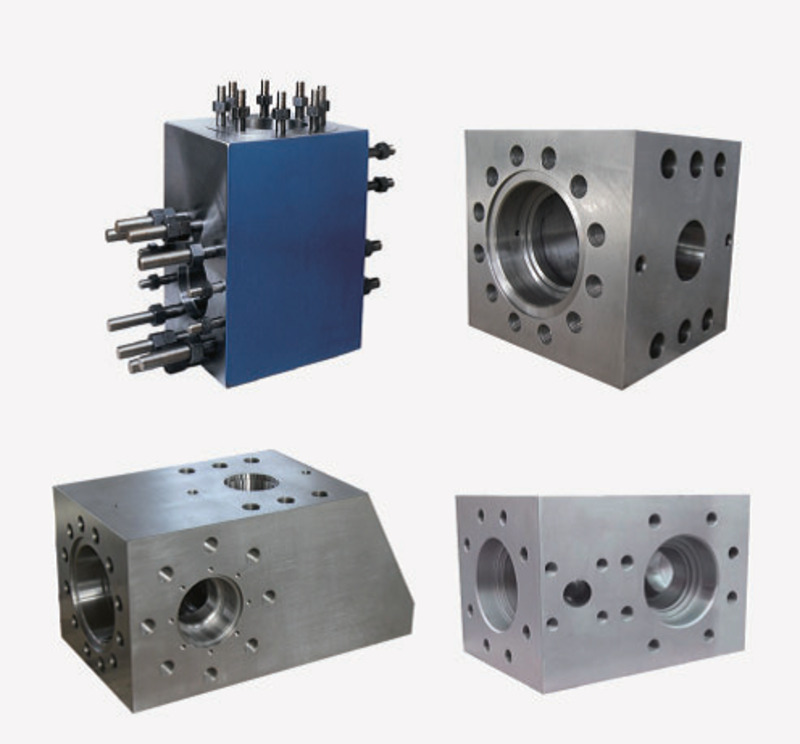
The term “mup pump liner” is confirmed to be a typo in industry terminology. The standardized technical term is mud pump liner, which refers to a replaceable cylindrical sleeve installed in the fluid end of mud pumps. As a critical component of the drilling fluid circulation system, it forms a sealed chamber with the piston to contain high-pressure drilling mud, withstand abrasive wear, and maintain hydraulic efficiency. Mud pump liners act as sacrificial barriers, protecting expensive pump components while ensuring volumetric efficiency through precise dimensional control and surface finish (14 Essential Insights: Your Definitive Guide to Mud Pump Liners).
1.1 API 7K 与 ISO 13503-2 官方定义
API 7K (2015 Edition) explicitly defines mud pump liners as “replaceable cylindrical sleeves for piston mud-pump components” with strict manufacturing and performance requirements. Key specifications include:
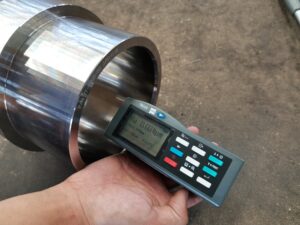
- Dimensional Tolerances: Bores ≥6 inches (152.4 mm) must be produced in 1/4-inch (6.35 mm) increments, while smaller bores use 1/2-inch (12.7 mm) increments. Bore tolerance is strictly controlled within +0.010″/-0.000″ to ensure piston compatibility and minimize fluid bypass (API Specification 7K).
- Material Integrity: Liners must undergo 50,000 pressure cycles at 125% of rated load to verify structural durability under extreme conditions (10 Critical Insights About Mud Pump Liners: Materials, Maintenance & Industry Standards).
- Marking Requirements: Each liner must bear the manufacturer’s name, “Spec 7K,” and size number, either cast, die-stamped, or affixed via a metal plate visible post-installation (API Specification 7K).
ISO 13503-2:2024 complements API standards by focusing on wear and corrosion resistance testing for materials used in harsh drilling environments. While primarily addressing proppant testing, it aligns with API 7K by validating liner performance in abrasive conditions, ensuring global compatibility for cross-border operations (ISO 13503-2:2024(en), Oil and gas industries).
1.2 行业文献一致性
Industry literature uniformly adopts “mud pump liner” as the exclusive technical term.权威出版物如:
- SPE Papers: Studies on drilling fluid dynamics, such as “Technical Analysis of Mud Pump Failures,” consistently reference mud pump liners when discussing wear mechanisms (Technical analysis of the failures in a typical drilling mud pump during field operation).
- IADC Manuals: The International Association of Drilling Contractors’ guidelines for mud pump maintenance explicitly use “mud pump liner” in assembly and replacement procedures (Mud Pump Liner and Piston Replacement: Best Practices Guide).
- OEM Whitepapers: Manufacturers like Forum Energy Technologies (FET) and National Oilwell Varco (NOV) use the term in product specifications, emphasizing compliance with API 7K standards for their bi-metal and ceramic liners (PDFLINERS – Forum Energy Technologies).
This consistency ensures clear communication across the oil and gas industry, eliminating ambiguity in technical discussions and procurement processes. For further details on material selection and maintenance, refer to Mud Pump Liners: 7 Definitive Factors for Choosing an Expert’s 2024 Guide.
二、Mud Pump Liner 应用场景与材料选型
Mud pump liners are critical components whose material selection directly impacts drilling efficiency, maintenance costs, and operational safety. Different drilling environments—characterized by varying pressure, temperature, and fluid abrasiveness—demand specialized liner materials to optimize performance. This chapter explores the optimal material choices for key application scenarios and provides a comparative analysis to guide engineering decisions.
2.1 常规陆地钻井
In onshore drilling operations with moderate pressure (≤7,500 psi) and medium sand content (typically 5–15% solids), bimetallic high-chromium cast iron liners are the industry standard. These liners combine a forged steel outer shell for structural strength with a centrifugally cast high-chromium inner sleeve (26–28% Cr) that achieves a hardness of HRC 60–65 after heat treatment. This design balances wear resistance and cost-effectiveness, with an average service life of 800–1,000 hours under standard conditions. The bimetallic construction ensures compatibility with API 7K specifications, making it suitable for most conventional rigs, including Bomco F1300 and National 12-P-160 pumps (Mud Pump Liner Specifications in Resource Extraction).
2.2 HPHT & 深海钻井
High-pressure, high-temperature (HPHT) wells (≥7,500 psi, >150°C) and deepwater environments with H₂S exposure (up to 24 ppm) require advanced materials like zirconia ceramic liners. These liners, composed of zirconia-toughened alumina (ZTA) or 99% alumina, offer exceptional hardness (HRA 85–92) and chemical inertness. Their mirror-like surface finish (Ra ≤ 0.2 μm) minimizes piston wear and ensures efficient sealing. In field trials, ceramic liners have demonstrated service lives of 2,000–4,000 hours—5–10 times longer than bimetallic alternatives—despite a 40% higher upfront cost. For example, offshore projects using GPE ceramic liners reported a 47% reduction in maintenance downtime and a 35% lower total cost of ownership (TCO) over 10,000 operating hours (GPE Ceramic Mud Pump Liner | High-Durability API 7K and The Evolution of Ceramic Liners: How Advanced Mud Pump Components Are Transforming Drilling Operations in 2025).
2.3 矿山与地质勘探
Mining and geological exploration drilling involve high-impact loads and abrasive slurries (e.g., bentonite mud with 20–30% solids), making bimetallic liners preferable over single-metal alternatives. Single-metal liners, typically carburized carbon steel with HRC 58–60 hardness, wear rapidly in high-impact environments, requiring replacement every 200–300 hours. Bimetallic liners, by contrast, leverage a high-chrome inner sleeve (HRC ≥62) and ductile steel outer shell to withstand shock loads, extending replacement cycles to 600–800 hours. This reduces downtime by 40% in mining operations, where equipment accessibility is often limited (Mud Pump Liners: 7 Definitive Factors for Choosing an Expert’s 2024 Guide).
2.4 材料性能对照表
To facilitate rapid material selection, the following table compares key parameters of common mud pump liner materials:
| Material | Hardness | Max Working Pressure | Typical Service Life | Relative Cost | Key Application |
|---|---|---|---|---|---|
| Single-Metal (Carbon Steel) | HRC 58–60 | ≤5,000 psi | 200–300 hours | Low (1x) | Light-duty onshore, low-abrasion mud |
| Bimetallic (High-Chrome) | HRC 60–65 | ≤7,500 psi | 800–1,000 hours | Medium (1.5x) | Conventional onshore, mining |
| Ceramic (Zirconia/Alumina) | HRA 85–92 | ≤10,000 psi | 2,000–4,000 hours | High (3x) | HPHT, deepwater, H₂S environments |
| Nickel-Based Alloy | HRC 60–64 | ≤8,500 psi | 1,500–2,000 hours | High (2.5x) | Geothermal, corrosive fluids |
Data sources: Mud Pump Liners: 5 Key Factors for Optimal Drilling Performance and Mud Pump Cylinder Liner – EB Castworld.
This table highlights that ceramic liners excel in extreme conditions but require higher initial investment, while bimetallic liners offer the best cost-to-performance ratio for most land-based operations. Engineers must balance operational demands with TCO, considering factors like downtime costs and material availability (Key Concerns about Mud Pump Liners in the Oil Drilling Rig Industry).
三、Mud Pump Liner 安装、维护与故障预防
Mud pump liner installation, maintenance, and故障预防 are critical aspects of ensuring the reliable and efficient operation of mud pumps in drilling operations. Proper handling of these processes not only extends the lifespan of the mud pump liner but also minimizes downtime and enhances overall drilling performance. This chapter provides a comprehensive guide to the IADC standard disassembly and assembly procedures, wear monitoring and preventive maintenance techniques, common故障 and corrective measures, as well as safety and compliance要点.
3.1 IADC 标准拆装流程
The International Association of Drilling Contractors (IADC) has established standard procedures for the safe and efficient disassembly and assembly of mud pump liners. Adhering to these procedures is essential to prevent accidents, ensure proper component alignment, and maintain the integrity of the mud pump system.
1. Lockout/Tagout (LOTO) Procedure Before commencing any work on the mud pump, it is imperative to implement a strict LOTO procedure to isolate all energy sources. This involves shutting down the pump, disconnecting the power supply, and placing locks and tags on the circuit breakers and control panels to prevent accidental startup. The LOTO procedure must be documented and verified by authorized personnel to ensure the safety of the maintenance crew (PDFSafety Alert – IADC).
2. Pressure Relief After securing the LOTO, all residual pressure within the mud pump system must be relieved. This is typically done by opening the bleed-off valves on the suction and discharge lines, as well as the liner wash system. Failure to properly relieve pressure can result in sudden release of high-pressure fluid, leading to severe injury or equipment damage (Working on Mud Pumps – IADC.org).
3. Liner Removal Once the system is depressurized, the liner can be removed. This involves:
- Disconnecting the liner cooling water hoses and cleaning the spray nozzles.
- Removing the piston rod clamp and separating the pony rod from the piston rod.
- Using a chain hoist to support the liner and loosening the liner lock ring (either threaded or bolted).
- Carefully extracting the liner from the fluid end using a crow bar and the chain hoist.
- Thoroughly cleaning the liner cavity and inspecting for wear or damage (Safe Mud Pump Operation Procedures | PDF – Scribd).
4. Inspection and Preparation The removed liner and related components should be inspected for signs of wear, scoring, or cracks. The liner seal and wear plate should be replaced if damaged. The liner cavity must be cleaned to remove any mud, debris, or old sealant. Additionally, the piston and piston rod should be inspected for wear or misalignment (Mud Pump Liner and Piston Replacement: Best Practices Guide).
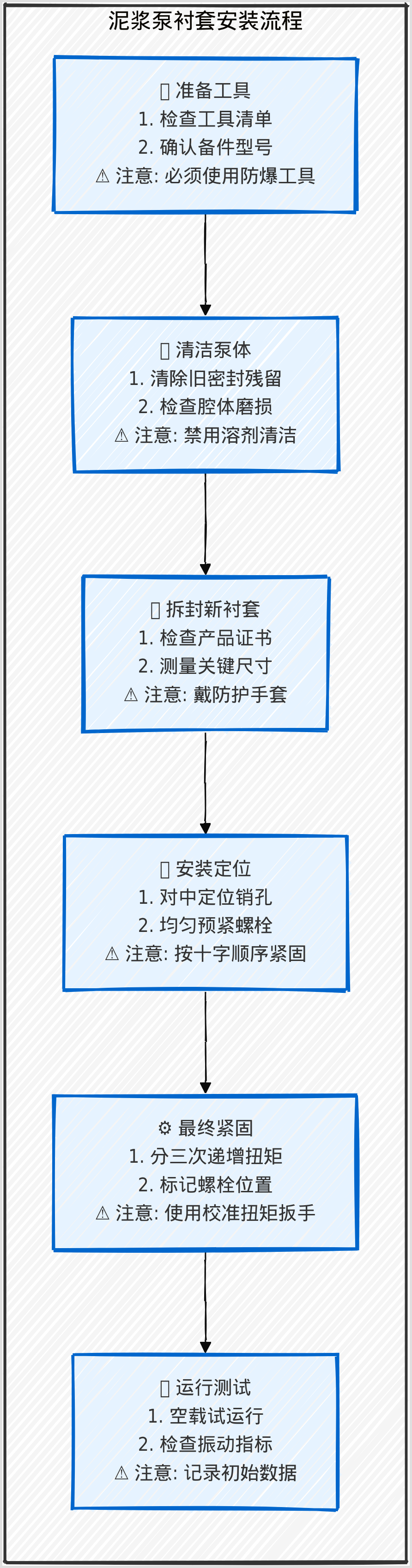
5. Liner Installation Installing the new or reconditioned liner involves:
- Applying a thin layer of grease to the liner’s outer surface and the inside of the liner cavity.
- Positioning the new liner seal in the cavity or on the liner itself.
- Using the chain hoist to carefully insert the liner into the cavity, ensuring proper alignment.
- Securing the liner lock ring or clamp and torquing to the manufacturer’s specifications.
- Reconnecting the piston rod clamp, cooling water hoses, and other components (Safe Mud Pump Operation Procedures | PDF – Scribd).
6. Post-Installation Checks After installation, the system should be reassembled, and a pressure test conducted to ensure there are no leaks. The pump should be cycled at low speed initially to verify proper operation, and all connections should be checked for tightness (Mud Pump Liner and Piston Replacement: Best Practices Guide).
3.2 磨损监测与预防性维护
Proactive wear monitoring and preventive maintenance are essential to maximize the service life of mud pump liners and minimize unplanned downtime. Implementing a structured maintenance program can significantly reduce operational costs and improve drilling efficiency.
1. Regular Liner Rotation To ensure even wear, mud pump liners should be rotated 90 degrees every 500 operating hours. This practice helps distribute wear uniformly around the liner circumference, extending its lifespan by up to 40% in some cases. Additionally, in multi-pump setups, liners can be swapped between different pump positions to balance wear (10 Key Factors of Mud Pump Liners for Oil Drilling Efficiency).
2. Ultrasonic Thickness Testing Ultrasonic thickness testing should be performed quarterly to measure the liner wall thickness. This non-destructive testing method can detect internal wear and corrosion that may not be visible during visual inspections. Liners should be replaced when the wall thickness decreases by more than 10% of the original specification or when eccentric wear exceeds 0.15mm (10 Key Factors of Mud Pump Liners for Oil Drilling Efficiency).
3. AI-Powered Predictive Maintenance Models Advanced AI-driven predictive maintenance models are increasingly being used to monitor liner condition in real-time. These models analyze data from sensors installed on the mud pump, such as vibration, temperature, and pressure, to predict potential failures before they occur. Field trials have shown that such systems can predict up to 85% of liner failures, allowing for planned maintenance during scheduled downtime (10 Key Factors of Mud Pump Liners for Oil Drilling Efficiency).
4. Fluid Analysis Regular analysis of the drilling fluid is crucial for preventing excessive liner wear. Parameters such as pH, sand content, and viscosity should be monitored weekly. High sand content (above 1-2%) can significantly accelerate abrasive wear, while extreme pH levels (below 6 or above 10) can cause corrosion. Adjusting the fluid properties based on analysis results can extend liner life and improve pump efficiency (10 Key Factors of Mud Pump Liners for Oil Drilling Efficiency).
5. Cooling System Maintenance The liner cooling system must be regularly inspected and maintained to prevent overheating, which can cause thermal cracking and premature failure. The cooling water should be kept clean, and the spray nozzles should be checked for blockages. In cold environments, RV antifreeze can be added to the cooling system to prevent freezing (Mud Pump Maintenance – Trenchless Technology Magazine).
6. Daily and Weekly Inspections Daily visual inspections should check for leaks, unusual noises, and excessive vibration. Weekly inspections include checking piston rod clamp bolts, cleaning valve seats, and verifying proper alignment of the power end and fluid end. These routine checks help identify potential issues early, preventing costly repairs and downtime (Routine maintenance and inspection of mud pump – Sino Mechanical).
3.3 常见故障与纠正措施
Despite proper maintenance, mud pump liners can experience various故障 due to the harsh operating conditions. Understanding these common issues and their corrective measures is essential for minimizing downtime and maintaining drilling operations.
1. Eccentric Wear Causes: Misalignment of the piston rod, bent crankshaft, or worn crosshead guides can lead to uneven contact between the piston and liner, resulting in eccentric wear. Additionally, improper installation or loose liner clamps can contribute to this issue. Symptoms: Uneven piston wear patterns, increased vibration (exceeding 2.5mm/s RMS), and reduced pump efficiency. Corrective Actions: Verify pump alignment using laser alignment tools, check and tighten foundation bolts, and replace bent piston rods or worn crosshead guides. Ensure proper liner installation and torque specifications are followed (10 Key Factors of Mud Pump Liners for Oil Drilling Efficiency).
2. Thermal Cracking Causes: Rapid temperature changes, inadequate cooling, or prolonged operation at high temperatures can cause thermal stress and cracking in the liner. Symptoms: Visible cracks on the liner surface, coolant leaks, or reduced pressure holding capacity. Corrective Actions: Implement gradual pump startup to avoid thermal shock, ensure the cooling system is functioning properly with adequate flow and clean coolant, and consider using zirconia liners with higher thermal shock resistance (up to 320°C) for high-temperature applications (10 Key Factors of Mud Pump Liners for Oil Drilling Efficiency).
3. Corrosion Pitting Causes: Exposure to corrosive drilling fluids (e.g., high H₂S content or low pH) can lead to pitting corrosion on the liner surface. Symptoms: Reddish-brown deposits, localized surface cavities (>0.5mm deep), and increased fluid bypass. Corrective Actions: Switch to chrome-plated or ceramic liners for corrosive environments, implement cathodic protection if H₂S levels exceed 200ppm, and add corrosion inhibitors to the drilling fluid weekly (10 Key Factors of Mud Pump Liners for Oil Drilling Efficiency).
3.4 安全与合规要点
Safety and compliance are paramount in mud pump liner maintenance to protect personnel and ensure adherence to industry standards and regulations.
1. Lockout/Tagout (LOTO) Compliance Strict adherence to LOTO procedures is mandatory before any maintenance work on mud pumps. All energy sources must be isolated, and locks and tags must be placed by authorized personnel. A pre-job safety meeting should be held to review the LOTO procedure and ensure all team members understand their roles (PDFSafety Alert – IADC).
2. Personal Protective Equipment (PPE) Maintenance personnel must wear appropriate PPE, including safety glasses, hard hats, gloves, steel-toed boots, and hearing protection. Additional PPE, such as face shields and chemical-resistant suits, may be required when handling corrosive fluids or high-pressure components (Working on Mud Pumps – IADC.org).
3. API 7K Pressure Cycle Testing Mud pump liners must comply with API 7K standards, which require testing for 50,000 pressure cycles at 125% of the rated load to ensure structural integrity. Regular pressure testing of the entire mud pump system should be conducted to verify compliance and identify potential leaks or weaknesses (API Specification 7K).
4. Training and Certification All personnel involved in mud pump maintenance should receive proper training on IADC and API standards, as well as equipment-specific procedures. Certification programs, such as IADC’s WellSharp, can help ensure that maintenance crews are knowledgeable and competent in safe practices (IADC Maintenace Checklist | PDF – Scribd).
5. Documentation and Record-Keeping Detailed records of maintenance activities, including liner rotations, ultrasonic thickness measurements, and pressure test results, should be maintained. This documentation helps track liner performance, identify trends, and demonstrate compliance with regulatory requirements (Mud Pump Liner and Piston Replacement: Best Practices Guide).
By following these installation, maintenance, and safety guidelines, operators can maximize the service life of mud pump liners, ensure safe operations, and optimize drilling efficiency. Regular monitoring, proactive maintenance, and strict adherence to industry standards are key to achieving these goals. For more detailed information on mud pump liner selection and maintenance, refer to Mud Pump Liners: 7 Definitive Factors for Choosing an Expert’s 2024 Guide.
四、采购与供应链:如何选到高性价比 Mud Pump Liner
在钻井设备采购决策中,mud pump liner 的选择不仅影响初始投资成本,更直接关系到长期运营效率与维护支出。本章从全生命周期成本(TCO)模型、供应商资质审核、库存策略及实际案例四个维度,提供科学采购框架,帮助采购团队在确保性能的前提下实现成本最优化。
4.1 TCO 计算模型
全生命周期成本(TCO)分析是平衡短期采购成本与长期运营效益的核心工具。其量化公式需整合以下三要素:
1. 初始采购成本(C₀)
包括 liner 本身价格、运输费用及关税。以 API 7K 认证的 5 英寸缸套为例,双金属高铬铸铁 liner 单价约 3,500–5,000,陶瓷 liner 则为 8,000–12,000(Mud Pump Liners: 7 Definitive Factors for Choosing an Expert’s 2024 Guide)。
2. 停机损失(C_downtime)
非计划停机导致的日损失可按钻机作业成本估算(如 shale 气井日租金约 20,000–30,000)。假设双金属 liner 平均每 800 小时更换一次,每次停机 8 小时,年停机成本为:
Cdowntime=(年作业小时L寿命)×单次停机时长×小时停机成本
例如,年作业 3,000 小时的页岩井,双金属 liner 年停机成本约 60,000,而陶瓷liner(寿命2,000小时)可降至24,000(The Evolution of Ceramic Liners: How Advanced Mud Pump Components Are Transforming Drilling Operations in 2025)。
3. 寿命小时数(L)
不同材料 liner 的寿命差异显著:
- 单金属 liner:200–300 小时
- 双金属 liner:800–1,000 小时
- 陶瓷 liner:2,000–4,000 小时(Guideline for selecting Mud Pump Liners- Part 1)
综合 TCO 公式:
TCO=C0+∑i=1n(Creplacement,i+Cdowntime,i)
其中,n 为 liner 在设备生命周期内的更换次数。通过该模型,陶瓷 liner 的高初始成本可在 1–2 年的使用周期内通过减少更换频率实现成本平衡(How to Select a Reliable Mud Pump Supplier?)。
4.2 供应商资质清单
合格供应商需满足以下核心资质,以确保产品可靠性与合规性:
1. API 7K 认证
作为行业强制标准,API 7K 规定了 liner 的材料性能、尺寸公差及压力循环测试要求(如 50,000 次循环测试)。需确认供应商提供的 API 证书在有效期内,且覆盖具体 liner 型号(API Specification 7K)。
2. ISO 9001 质量管理体系
该认证确保供应商具备标准化生产流程,包括原材料检验、热处理控制及成品测试。例如,ISO 9001 认证企业的 liner 尺寸公差可控制在 ±0.01mm 以内(How to Select a Reliable Mud Pump Supplier?)。
3. CE 认证(适用于欧盟市场)
证明产品符合欧盟健康、安全及环保标准,涉及材料毒性、机械强度等指标(Mud Pump Liner Market’s Evolutionary Trends 2026-2034)。
4. 第三方检测报告
需提供权威机构(如 SGS、Intertek)出具的材料成分分析(如高铬铸铁的 Cr 含量 ≥26%)、硬度测试(HRC ≥62)及疲劳寿命验证报告(Mud Pump Liners: 7 Definitive Factors for Choosing an Expert’s 2024 Guide)。
4.3 库存与交货周期策略
合理的库存管理可显著降低供应链风险,避免因 liner 短缺导致停机。建议采取以下策略:
1. 安全库存计算
基于钻井计划与供应商交货周期,按公式确定最低库存:
安全库存=日均消耗量×(交货周期+安全缓冲天数)
例如,某项目日均消耗 1 个双金属 liner,供应商交货周期 14 天,安全缓冲 7 天,则安全库存为 21 个(Mud Pump Liner and Piston Replacement: Best Practices Guide)。
2. 与 OEM 签订快速交付协议
选择在目标区域设有仓库的供应商(如 NOV、Forum Energy Technologies),并签订 48 小时紧急交付协议,协议中需明确违约赔偿条款(如延迟交付按日扣除 1% 货款)(Types of Mud Pump Liners: A Complete Guide to Choosing the Right Option)。
3. ABC 分类管理
- A 类:陶瓷 liner 等高价、低消耗部件,采用“少量多次”采购策略;
- B 类:双金属 liner,维持中等库存;
- C 类:密封件等低值耗材,批量采购以降低单价(Classification and selection of mud pump spare parts)。
4.4 案例:页岩气项目批量采购
北美 Permian 盆地某页岩气运营商的案例证明,科学采购可显著降低综合成本。该项目在 2024 年将 20 台钻机的双金属 liner 替换为 zirconia 陶瓷 liner,具体成效如下:
- 维护成本降低 35%:陶瓷 liner 寿命(2,500 小时)是双金属 liner(800 小时)的 3 倍,年更换次数从 4 次降至 1.2 次,节省人工与停机成本约 $1.2M/年(The Evolution of Ceramic Liners: How Advanced Mud Pump Components Are Transforming Drilling Operations in 2025)。
- TCO 优化:尽管陶瓷 liner 初始采购成本增加 600K,但通过减少停机损失(800K/年)与更换费用($400K/年),18 个月实现成本回收(Mud Pump Fluid End Design: Impact on Performance and Longevity)。
- 数据支持:该案例中,运营商通过 AI 预测性维护系统(如 LSTM 算法)将 liner 更换计划准确率提升至 85%,进一步减少非计划停机(Mud Pump Health Assessment Using Unsupervised Learning Models on High-Frequency Rig Data)。
通过 TCO 模型量化分析、严格资质审核与灵活库存策略,采购团队可在保障钻井效率的同时实现成本最优化,而陶瓷 liner 等高端材料在高负荷场景下的长期经济性已得到行业验证。
五、未来趋势:智能监测与新材料革命
The mud pump liner industry is undergoing a transformative phase driven by advancements in digital technologies and material science. This chapter explores emerging trends that are redefining operational efficiency, durability, and supply chain resilience for mud pump liners in high-pressure, high-abrasion drilling environments.
5.1 数字孪生与AI预测性维护
The integration of digital twin technology and artificial intelligence (AI) is revolutionizing mud pump liner maintenance. A key breakthrough is the development of LSTM (Long Short-Term Memory) algorithm-based life prediction systems, which analyze high-frequency sensor data to forecast liner degradation and prevent unplanned downtime.
How LSTM Algorithms Drive Predictive Maintenance
LSTM models process real-time data streams from vibration, pressure, and temperature sensors installed on mud pumps. By learning from historical failure patterns and operational conditions, these systems can:
- Detect early anomalies: Subtle changes in vibration frequency (>2.5mm/s RMS) or pressure pulsations are identified as precursor signs of eccentric wear or crack formation (Mud Pump Health Assessment Using Unsupervised Learning Models on High-Frequency Rig Data).
- Predict remaining useful life (RUL): Field trials with a fleet of 27 rigs implementing LSTM-based digital twins reported an 80% reduction in unplanned downtime and 90% fewer maintenance-related credits issued to operators (PDFIADC/SPE-230717-MS A Case Study on the Design and Operational Impact of a Modular Digital Twin Solution for Drilling Equipment Reliability).
- Optimize maintenance schedules: By correlating liner wear rates with drilling fluid properties (e.g., sand content >2%) and operating pressure, the AI system recommends proactive replacements during scheduled shutdowns, avoiding costly emergency repairs (Mud Pump Health Assessment Using Unsupervised Learning Models on High-Frequency Rig Data).
Practical Implementation
Operators like Nabors Industries have deployed such systems, integrating them with rig control platforms to provide real-time dashboards for maintenance teams. The technology has proven particularly effective in HPHT wells, where sudden liner failures can lead to well control incidents (Machine Learning Drives Drilling Efficiency at IADC/SPE Conference).
5.2 陶瓷增韧与涂层技术
Material innovation continues to push the boundaries of mud pump liner performance. Two technologies are emerging as game-changers for extreme drilling conditions: zirconia-toughened alumina (ZTA) ceramics and nanocomposite coatings.
Zirconia-Toughened Alumina (ZTA) Ceramics
ZTA liners combine the hardness of alumina (HRA 85–92) with the toughness of zirconia, addressing the brittleness of traditional ceramics. Key advancements include:
- Extended service life: In field tests, ZTA liners achieved 2,000–4,000 operating hours in high-sand-content muds, 5–10 times longer than bimetallic alternatives (The Evolution of Ceramic Liners: How Advanced Mud Pump Components Are Transforming Drilling Operations in 2025).
- Thermal shock resistance: ZTA liners withstand temperatures up to 350°F and rapid pressure cycles, making them ideal for geothermal and deepwater wells with H₂S exposure (7K Ht400 Ceramic Liner Ceramic Liners for Mud Pump).
Nanocomposite Coatings
Nanostructured coatings (e.g., titanium nitride) are being applied to bimetallic liners to enhance wear resistance. These coatings:
- Reduce friction by 30% compared to uncoated surfaces, lowering piston wear (Mud Pump Piston and Liner: Performance & Compatibility).
- Improve corrosion resistance in acidic muds (pH <6), extending liner life by 40% in mining applications (Guideline for selecting Mud Pump Liners- Part 1).
5.3 标准化推动跨品牌互换
The adoption of API 7K dimensional standards is streamlining liner procurement and reducing supply chain risks. Key outcomes include:
Unified Dimensional Tolerances
API 7K (2015 Edition) mandates strict bore tolerances (±0.010 inches for liners ≥6 inches) and standardized increments (1/4-inch for bores ≥6 inches, 1/2-inch for smaller sizes), enabling cross-brand compatibility (API Specification 7K). This eliminates the need for custom liners, reducing inventory costs by 25% for operators with mixed fleets of NOV, Gardner Denver, and Bomco pumps (Mud Pump Liners: 7 Definitive Factors for Choosing an Expert’s 2024 Guide).
Global Supply Chain Resilience
Standardization allows operators to source liners from multiple certified suppliers, mitigating geopolitical or logistical disruptions. For example, European operators can now substitute Asian-manufactured liners without modifying pump fluid ends, ensuring continuity in remote offshore projects (Mud Pump Liner Market’s Evolutionary Trends 2026-2034).
5.4 结语与行动建议
To capitalize on these trends, drilling operators should adopt a three-step strategy:
- Liner Selection: Prioritize ZTA ceramics for HPHT wells and nanocoated bimetallics for cost-sensitive onshore operations. Use the TCO model (initial cost + downtime + replacement frequency) to justify premium materials (The Evolution of Ceramic Liners: How Advanced Mud Pump Components Are Transforming Drilling Operations in 2025).
- Predictive Maintenance: Deploy AI-driven monitoring systems (e.g., LSTM algorithms) to track liner health in real time. Integrate data from drilling fluid analysis (sand content, pH) to refine RUL predictions (Mud Pump Health Assessment Using Unsupervised Learning Models on High-Frequency Rig Data).
- Supply Chain Optimization: Partner with API 7K-certified suppliers and maintain safety stock based on lead time (e.g., 48-hour emergency delivery agreements) (How to Select a Reliable Mud Pump Supplier?).
Industry Collaboration: Stay updated on research from SPE and IADC, such as ongoing studies on AI-driven anomaly detection and next-generation ceramic materials (SPE Technical Papers Available for Download — February 2026). By aligning with these advancements, operators can reduce costs, enhance safety, and gain a competitive edge in complex drilling environments.